
Amazon Selling Partner
Amazon Selling Partner is one of the world's largest online marketplaces. Amazon provides a platform for sellers to showcase and offer their products to a vast customer base, spanning across various categories and regions. Their Selling Partner APIs provide access to a wide range of data, including orders, inventory, and reports.
Features
| Feature name | Supported | |
|---|---|---|
| Column Hashing | True | Field level |
| Blocking | True | Field level |
| Incremental | True | |
| Custom data | False | |
| History | False | |
| ReSync | True | Table level |
| Templates | False |
Personally Identifiable Information is not available for Amazon Orders
Data Schema
The table settlement_report syncs data from automatically generated reports
from Amazon. We do not have control over when the reports are generated.
Because of this, there might be days when no new data is synced.
These reports are retained for 90 days, after which they are deleted by
Amazon. Because of this, Weld will not be able to sync data for the
settlement_report table that is older than 90 days.
Setup Guide
Weld supports two authentication methods for Amazon Selling Partner. You can choose whichever works best for your setup:
- Private app — use credentials from your own SP-API application (recommended for full control)
- Weld OAuth — authenticate through Weld's shared application (no SP-API registration needed)
Authentication with Private app
Step 1 - Credentials from your Amazon Account
Login to your Amazon Selling Partner Account, and register a private application (find out more here: Amazon Developer Docs - Register your application). You can also read more about self authorization here If you already have an application for APIs, feel free to use it.
From this application, you get access to:
- Refresh token
- App client ID
- App client Secret
Step 2 - Add credentials to Weld App
Register the credentials generated for the app. Furthermore, you need to specify the region you account is registered at.
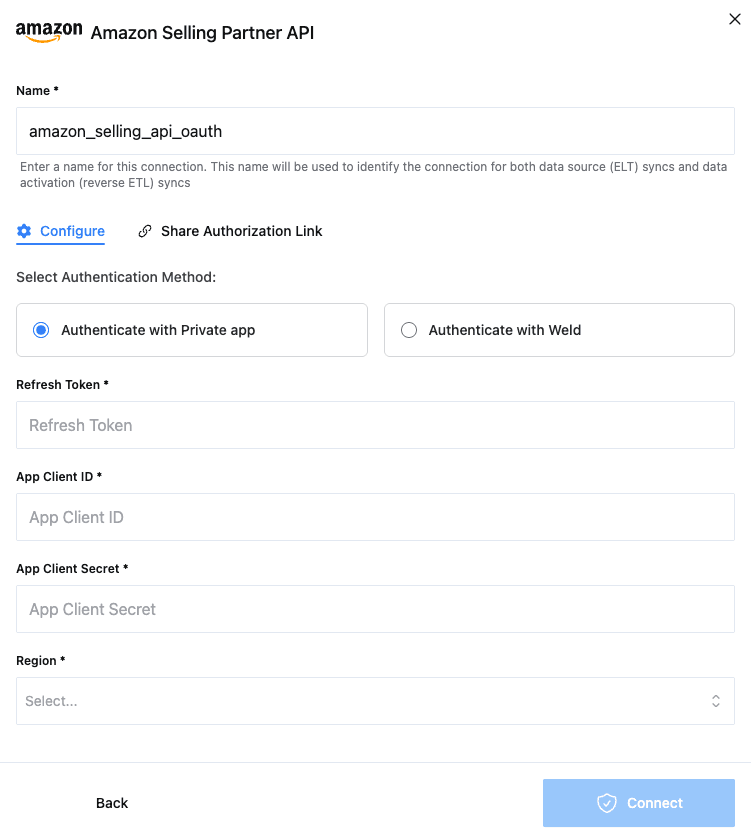
Step 3 - Connect
Click connect, and authorize Weld to your Amazon Selling Partner account.
Authentication with Weld
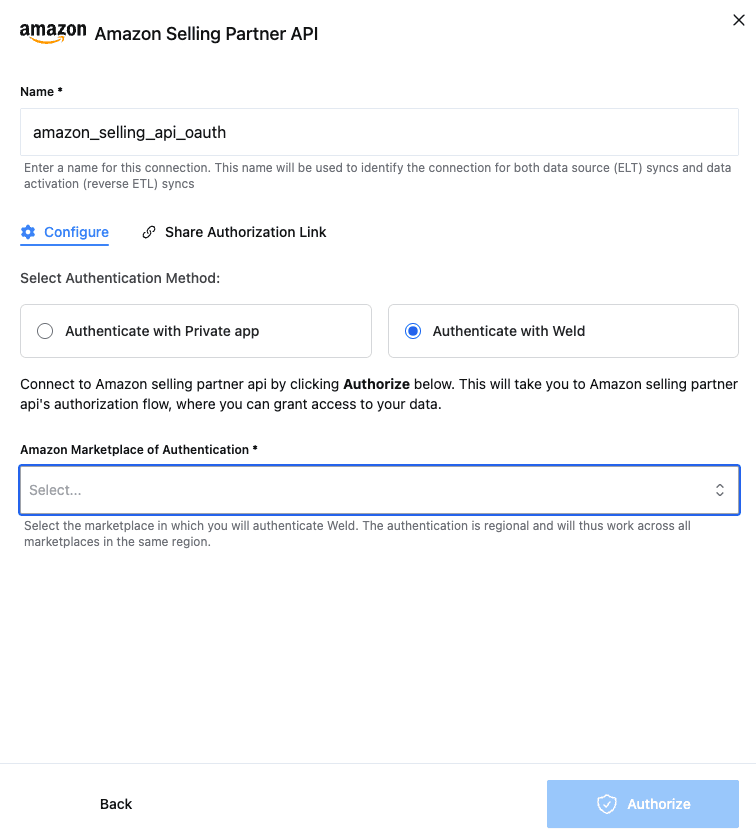
Step 1 - Set up connection in Weld App
Choose the region where you would like to authenticate After this click Authorize and follow the instructions
Sync setup
Step 1 - Data To Sync
- Select the pre-built reports you wish to include in the sync.
You can view the schema, remove columns or hash sensitive information.
Step 2 - Configure Sync
- Select how often you would like the data to sync.
- Provide a unique destination table name.
Weld will take over from here and commence syncing data from your Amazon Selling account.
Data Retention & Limitations
If you perform a full re-sync (resetting the table), any data older than the retention periods listed below will be permanently lost, as Weld can only retrieve what is currently available via Amazon's API. Proceed with caution when resetting these tables.
Amazon limits the availability of historical data for certain reports.
| Report Name | Data Retention Period |
|---|---|
| Settlement Report | 89 days |
| Search Query Performance | 15 months |
| FBA SNS Performance | 4 weeks |
| FBA SNS Forecast | Current Week (No history) |
Switching to Private app authentication
If you're currently using Weld's shared OAuth and would like to switch to your own SP-API application credentials, follow the steps below. This is optional — both methods are fully supported.
Prerequisites
Before starting, make sure you have:
- A registered SP-API application -- Register a private application in Amazon Seller Central if you don't already have one.
- Client ID and Client Secret -- Available from your SP-API application's credentials page.
- Refresh Token -- Generated by completing the self-authorization flow for your application.
Steps
- Log in to your Weld workspace and go to Settings → Connectors.
- Select the Amazon Selling Partner connection.
- Click Configuration.
- Select Authenticate with Private app as the authentication method.
- Enter the Refresh Token, App Client ID, and App Client Secret from your SP-API application.
- Select the Region your Amazon account is registered in.
- Click Authorize to reauthenticate the connection.
- Trigger a test sync to confirm everything is working correctly.