
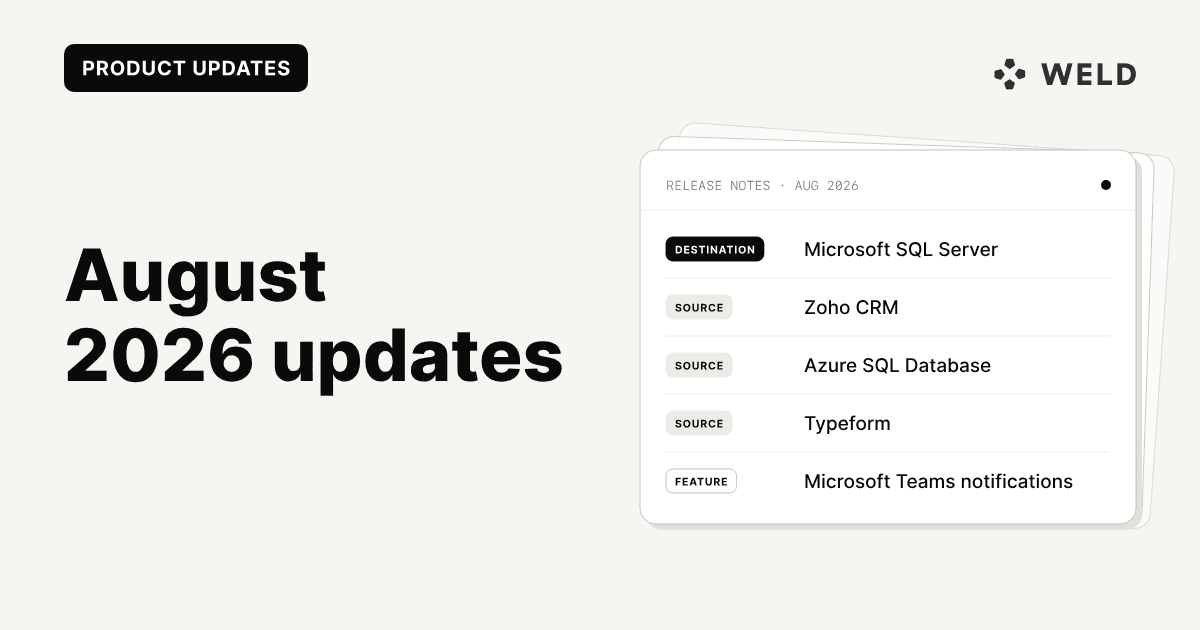
August was a connector month. We added five new sources: Zoho CRM, Typeform, Grin, Zigpoll, and Azure SQL Database. Microsoft SQL Server came online as a destination, so it now works in both directions. Weld can send notifications to Microsoft Teams alongside email and Slack, the MCP server and REST API picked up three new capabilities, and the Criteo connector now syncs real campaign and ad data.
Since the month closed, Weld has also been listed in Claude's connector directory, so adding the Weld MCP server to Claude is now a click and a login instead of pasting an endpoint into a dialog.
Here's everything new and improved in Weld this month.
New Features
Microsoft Teams Notifications
Weld can now send account notifications to a Microsoft Teams channel, alongside email and Slack. Connect a channel from your workspace notification settings by pasting an incoming webhook URL, which Weld validates by posting a hello card before saving it.
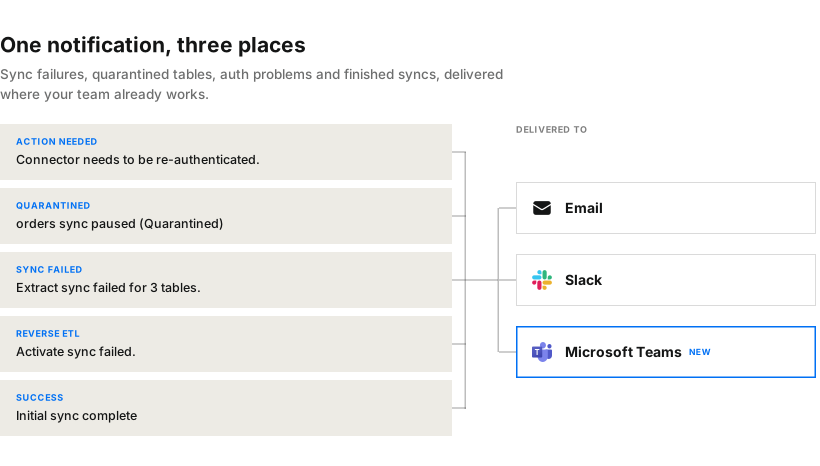
Everything Weld already notifies you about goes to the channel as Adaptive Cards: a table that fell into quarantine, an extract sync that failed, a Reverse ETL sync that failed, a connector whose credentials need re-authenticating, and the cheerful ones too, like an initial sync finishing.
Reauthorize a Connection From Your AI Assistant
That first notification in the list above, the one asking you to re-authenticate a connector, now has a much shorter path to being fixed.
The Weld MCP Server can now recover connections whose credentials have expired or been revoked, without you leaving your assistant. When list_failed_syncs reports an auth error, the assistant calls the new reauthorize_connection tool to mint a short-lived authorization link for that connection and hands it to you to complete in a browser.
Reauthorizing updates the existing connection in place, so every ELT and Reverse ETL sync attached to it keeps working with no reconfiguration.
Set a Transform's Schedule via API
A model published as a table is rebuilt either on a schedule of its own or as part of an Orchestration Workflow. Setting that schedule has always been possible in the app. This month it became possible from the MCP server and REST API as well.
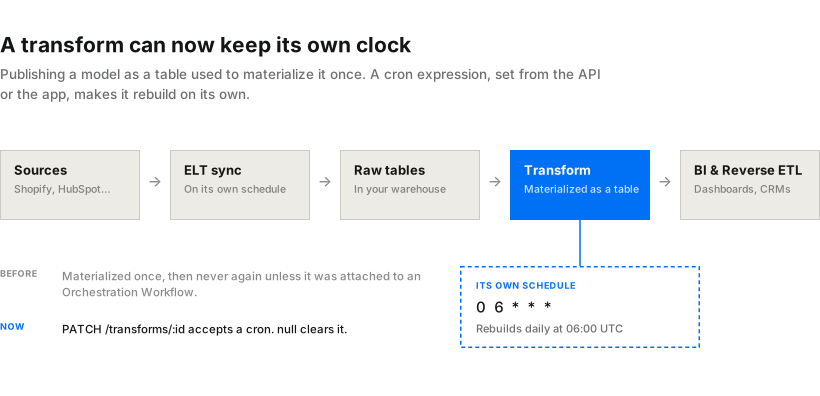
PATCH /transforms/:id and the update_transform tool now accept a cron_expression in UTC, with null clearing it. POST /transforms and bulk_create_transforms accept it too and apply it once the transform is published. That matters most for anything building pipelines programmatically: before this, a transform created through the API had no schedule of its own, so unless you attached it to a workflow it materialized once and then quietly went stale.
It applies to a published transform materialized as a table that isn't already attached to an Orchestration Workflow, and it round-trips: GET /transforms/:id returns the cron_expression back to you.
Per-Table Sync Intervals via API
Giving an individual ELT source table its own cron schedule, pulling it out of its sync's shared schedule so it runs independently, is now available through the MCP server and REST API as well as the app.
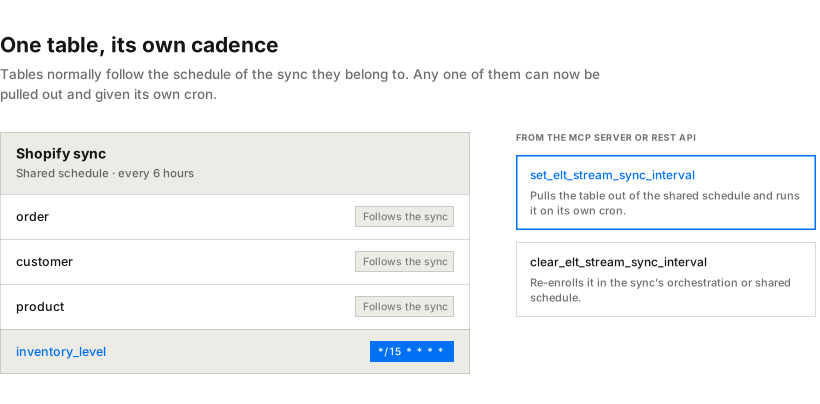
The new set_elt_stream_sync_interval and clear_elt_stream_sync_interval tools, and the POST /elt_streams/:id/set_sync_interval and POST /elt_streams/:id/clear_sync_interval endpoints, let you manage table schedules programmatically. Clearing the interval re-enrolls the table in its sync's orchestration or shared schedule.
New Destinations
Microsoft SQL Server
Microsoft SQL Server is now available as a data warehouse and ELT destination, in addition to its long-standing role as a source. SQL Server on Amazon RDS and Azure SQL Database get the same roles, since they run the same database engine.
ELT loads are bulk-copied into a temp table and then merged for incremental syncs, or truncated and inserted for full syncs, all inside a single transaction. An optional page compression setting lets you trade CPU for disk and read throughput on the tables Weld creates. Renaming a model recreates its view under the new name, and dependent SQL Server views are refreshed automatically so their column lists and types stay in sync.
New Connectors
Zoho CRM
Zoho CRM is now available as a source, covering 12 tables across the core CRM objects. Every table syncs incrementally on the record's modified timestamp, so each run only fetches what changed since the last sync.
Connections authorize through Zoho's OAuth flow and are pinned to your account's data center. US, EU, India, Australia, Japan, UK, Saudi Arabia, and Canada are all supported.
12 total changes
| Table/column | Change type | Notes |
|---|---|---|
account | New table | |
call | New table | |
campaign | New table | |
contact | New table | |
deal | New table | |
event | New table | |
lead | New table | |
note | New table | |
price_book | New table | |
product | New table | |
task | New table | |
user | New table |
We published a field-by-field walkthrough of all 12 tables, the three joins that actually exist between them, and four free SQL models to start from: Zoho CRM in Your Data Warehouse: Schema and SQL Models.
Explore Zoho CRM documentation →
Typeform
Typeform is now available as a source, syncing workspaces, forms, responses, and themes via OAuth. Forms and responses sync incrementally, and the form structure is fully modeled: fields, choices, type-specific properties, hidden fields, and logic rules with their actions and conditions each land in their own table, so you can join a response answer back to the exact question that produced it.
11 total changes
| Table/column | Change type | Notes |
|---|---|---|
workspace | New table | |
form | New table | Incremental, synced newest-first. |
response | New table | Incremental. |
theme | New table | |
workspace | ||
workspace_member | New table | |
form | ||
form_field | New table | A form's fields, with grouped fields flattened to the same shape. |
form_logic | New table | A form's logic rules, with actions and conditions in nested tables. |
form_field | ||
form_field_choice | New table | |
form_field_property | New table | Key/value pairs for a field's type-specific properties. |
response | ||
response_answer | New table | One row per answered field, with selected choices resolved to a sibling table. |
response_variable | New table | |
Explore Typeform documentation → · View Typeform data schema →
Grin
Grin is now available as a source, syncing more than 40 tables from the influencer marketing platform. Coverage spans creators and their contact details, brands and teams, campaigns and activations, proposals and deliverables, published content with its performance stats, affiliate links and discount codes, conversions, and creator payments. That is enough to model influencer ROI end to end: what you paid a creator, what they published, and what it converted.
Connections authenticate with an API key and support a custom sync start date.
Zigpoll
Zigpoll is now available as a source, syncing accounts, polls, slides, responses, participants, emails, insights, and webhooks from the survey and feedback platform. Polls, slides, and responses sync incrementally, and participants carry subtables linking them to the polls they saw and the responses they gave.
8 total changes
| Table/column | Change type | Notes |
|---|---|---|
account | New table | Includes a subtable of account admins. |
poll | New table | Incremental. Includes a subtable of page rules. |
slide | New table | Incremental. Includes subtables of answers and logic rules. |
response | New table | Incremental. Includes a subtable of answers. |
participant | New table | Includes subtables of polls, slides, tracked emails, and responses. |
email | New table | |
insight | New table | Includes a subtable of insight items. |
webhook | New table |
Connections authenticate with an API key and require a Zigpoll Advanced plan or higher.
Explore Zigpoll documentation →
Azure SQL Database
Azure SQL Database is now available as a source in its own right. It runs the same engine as Microsoft SQL Server and speaks the same protocol, so it supports the same sync modes.
Both authentication paths work: a SQL login, and Microsoft Entra ID via a service principal, which is required for servers with Entra-only authentication enabled. The Entra app registration stays in your own tenant rather than Weld's. Connections through an SSH tunnel are supported, and syncing a paused, auto-resuming serverless database now waits out the database's resume instead of failing.
Explore Azure SQL Database documentation →
Connector Updates
Criteo: Campaigns, Ads, Creatives & Daily Statistics
Criteo now syncs real data. New tables cover Advertiser, Campaign, Ad, and Creative, with subtables for image sets, layouts, logos, videos, and HTML tag attributes, plus incrementally synced Campaign Statistics and Ad Statistics daily reports. Statistics reports require a Currency setting, support an optional Timezone setting, and respect the connection's configured sync start date.
6 total changes
| Table/column | Change type | Notes |
|---|---|---|
advertiser | New table | |
campaign | New table | |
ad | New table | |
creative | New table | Includes subtables for image sets, layouts, logos, videos, and HTML tag attributes. |
campaign_statistics_daily_report | New table | Incrementally synced. |
ad_statistics_daily_report | New table | Incrementally synced. |
Klaviyo: Predictive Analytics on Profiles
The Klaviyo profile table now requests Klaviyo's predictive analytics data and syncs it as additional columns: historic and predicted customer lifetime value, order counts, average order value, average days between orders, churn probability, and the expected date of the next order. A new subtable ranks each profile's affinity for marketing channels.
That means you can segment on predicted CLV or churn risk directly in SQL, rather than only inside Klaviyo.
10 total changes
| Table/column | Change type | New name | Notes |
|---|---|---|---|
profile | |||
column | New Column | attributes_predictive_analytics_historic_clv | |
column | New Column | attributes_predictive_analytics_predicted_clv | |
column | New Column | attributes_predictive_analytics_total_clv | |
column | New Column | attributes_predictive_analytics_historic_number_of_orders | |
column | New Column | attributes_predictive_analytics_predicted_number_of_orders | |
column | New Column | attributes_predictive_analytics_average_days_between_orders | |
column | New Column | attributes_predictive_analytics_average_order_value | |
column | New Column | attributes_predictive_analytics_churn_probability | |
column | New Column | attributes_predictive_analytics_expected_date_of_next_order | |
profile_predictive_analytics_ranked_channel_affinity | New table | Ranked marketing channel affinity per profile. | |
HubSpot: Teams, Users & Feedback Submissions
HubSpot gained four tables this month. team, team_user, and user give you per-user team assignments, so manager and role attribution can be modeled in the warehouse instead of hard-coded in a report. feedback_submissions syncs survey response records along with their contact associations.
5 total changes
| Table/column | Change type | Notes |
|---|---|---|
team | New table | HubSpot team names. |
user | New table | HubSpot user records, including email, role, and primary/secondary team assignments. |
feedback_submissions | New table | Feedback submission (survey response) records. |
team | ||
team_user | New table | Per-user team membership, including secondary team assignments. |
feedback_submissions | ||
feedback_submission_association | New table | Associations between feedback submissions and contacts. |
The team and user tables rely on new optional HubSpot scopes. Reconnect the HubSpot source to grant them if you'd like to sync those tables.
Google Ads: Three New Tables
Google Ads picked up three new tables. search_term_keyword_stats is the search_term_view report at keyword grain, so search terms are attributed to the specific keyword that triggered them. It sits alongside the existing search_term_stats table, which keeps its previous shape. campaign_bidding_strategy is the campaign-level counterpart to ad_group_bidding_strategy, covering manual CPC, target CPA, target ROAS, target spend, target impression share, and percent CPC fields. campaign_bid_modifier carries per-campaign bid adjustments.
3 total changes
| Table/column | Change type | Notes |
|---|---|---|
search_term_keyword_stats | New table | search_term_view at keyword grain. |
campaign_bidding_strategy | New table | Campaign-level bidding strategy settings. |
campaign_bid_modifier | New table | Per-campaign bid adjustments. Synced in full on every run. |
Microsoft Ads: Search Term Report
Microsoft Ads now supports a search_query_performance_daily_report table, syncing the Search Term report alongside the existing account, campaign, ad group, ad, and keyword performance reports. It syncs daily and incrementally, with a 36 month retention window.
Facebook Ads: Rolling Windows for Custom Reports
Facebook Ads custom reports now support a rolling window option of 7, 14, 28, or 30 days, as an alternative to calendar-aligned aggregation. Instead of weekly buckets starting on Monday or monthly buckets on the 1st, a rolling window produces one row per day covering the trailing N days ending on that date.
This is what you need for deduplicated reach and frequency: Meta only deduplicates reach within the exact window you request, so a 28 day reach figure cannot be derived by summing 28 daily ones. Rolling window is mutually exclusive with a non-daily aggregation on the same report.
Younium: Subscription Version History
Younium now supports a subscription_version table, syncing the full version history of each subscription (every order that changed it) alongside its products, charges, milestones, and discounts as they stood at that version. It makes point-in-time subscription reporting possible: what a customer was actually paying for on any given date, rather than only their current state.
5 total changes
| Table/column | Change type | Notes |
|---|---|---|
subscription_version | New table | One row per subscription order/version. |
subscription_version | ||
subscription_version_product | New table | Products on that version. |
subscription_version_milestone | New table | Milestones on that version. |
subscription_version_discount | New table | Discounts on that version. |
subscription_version_product | ||
subscription_version_product_charge | New table | Charges on each product, with tiered pricing, features, and order discounts in nested tables. |
Additional Connector Updates
- Traede: Four new tables.
customer,production_order, andproduction_order_delivery_noteall sync incrementally, with line items and metadata in nested tables, and ausertable lets other tables that reference a user be resolved to a name. - TikTok Ads: GMV Max reports sync again after TikTok began rejecting requests for one metric. Weld also now recommends
gmv_max_campaign_daily_detailed_report, which TikTok is standardizing on going forward.
Bug Fixes
- Traede categories never landing: The
categorytable was filtering on the sync's start date like every other table, even though categories are written once and rarely touched again. That window returned nothing rather than a recent subset, so the table stayed empty on every run. It now reads every category on the first run and narrows to what changed on later runs. - Sync history hiding tables: The sync history timeline on a data source's History tab showed fewer tables than the Overview tab. Subtable tables and tables with no runs in the visible window are now included, alongside their synced row counts.
On the Blog
Weld Is in the Claude Connector Directory
The Weld MCP server itself has not changed: same https://connect.weld.app/mcp endpoint, same Streamable HTTP, same OAuth. What changed is finding it. Instead of Add custom connector and pasting an endpoint, you open Browse directory, search for Weld, and click Connect. If you already added Weld as a custom connector, there's nothing to do.
What's worth knowing is what sits behind that button, because it's more than a read-only window onto a warehouse. Claude can create and manage ELT syncs, write and publish SQL transforms, chain both into scheduled orchestration workflows, push modeled data back out through Reverse ETL, and run ad hoc queries. Every stage of the pipeline is a tool rather than a dashboard, so a failed sync gets investigated and re-run in the same thread where someone noticed the number looked wrong.
Two New SQL Guides
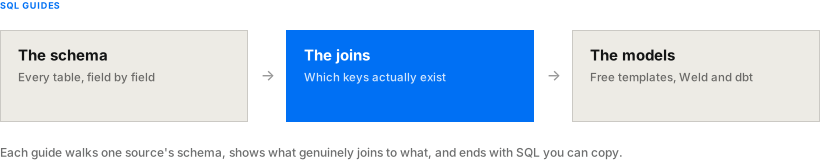
Both of August's guides follow that shape, and both come with free templates to start from:
- Zoho CRM in Your Data Warehouse: Schema and SQL Models goes through all 12 tables field by field, maps the three joins that actually exist between them (three of the twelve tables have no usable key at all, and there's no link between an activity and the deal it was about), and ends with four models for pipeline, lead conversion, and activity reporting.
- Amazon Seller Central & Vendor Central Reports in SQL builds ordered sales, settlement fees, ASIN profitability, and vendor shipped COGS, including how to keep Seller and Vendor numbers from being double counted when you sell through both.
That's a wrap for August! For the full technical details, check out the August 2026 release notes.
Questions or feedback? Reach out to us anytime.