
Change data capture (CDC) replicates only the rows that changed in your source database, rather than re-syncing entire tables. It is the foundation for real-time data pipelines, operational analytics, and event-driven architectures.
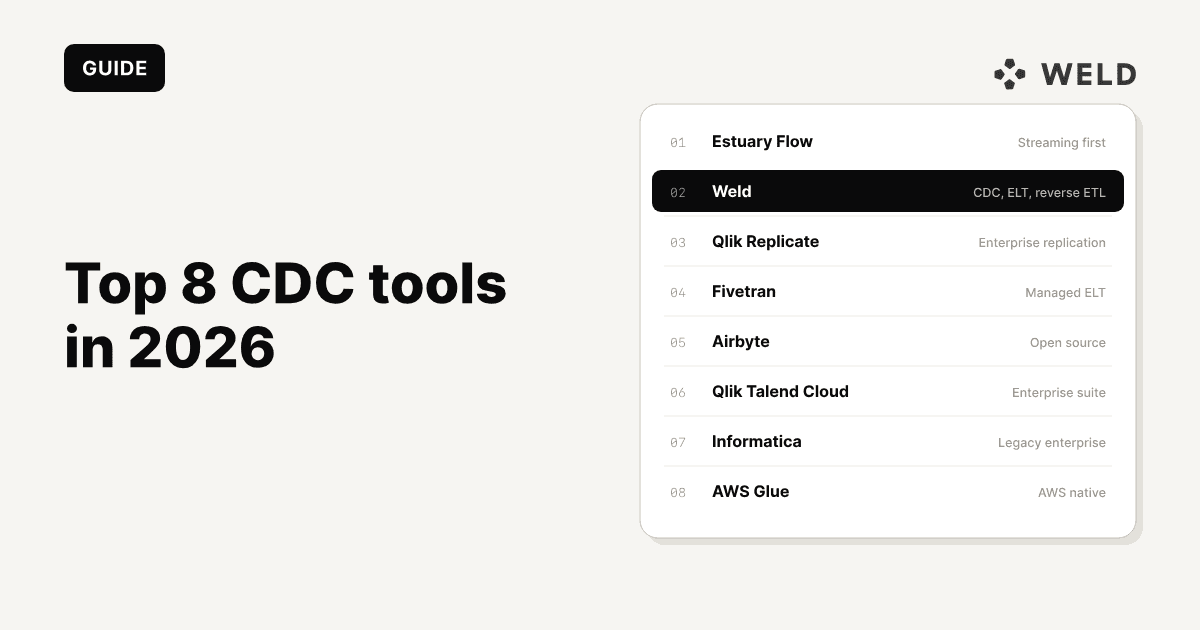
The best CDC tools in 2026 are Estuary Flow (best streaming-first CDC), Weld (best CDC + ELT + reverse ETL in one platform), and Qlik Replicate (best enterprise database replication). The right choice depends on latency requirements, source database types, and whether you also need ELT or reverse ETL.
This guide reviews 8 tools with CDC capabilities, compares their approach to change data capture, and helps you choose the right one for your stack.
For a broader comparison of ETL/ELT tools, see our Top 15 Best ETL Tools in 2026 or the 50+ ETL Tools Directory.
What is CDC?
Change Data Capture (CDC) is a method of detecting and capturing changes (inserts, updates, deletes) made to a database, then delivering those changes to a downstream system in near real-time.
CDC typically works through one of three mechanisms:
| Method | How it works | Latency | Source impact |
|---|---|---|---|
| Log-based | Reads the database transaction log (WAL, binlog, redo log) | Seconds | Minimal |
| Query-based | Polls the source table for changes using timestamps or sequence IDs | Minutes | Moderate |
| Trigger-based | Database triggers fire on insert/update/delete and write to a change table | Seconds | Higher |
Log-based CDC is the gold standard: lowest latency, lowest source impact, and captures deletes reliably. Most modern CDC tools use log-based replication.
CDC Tool Comparison Table
| Tool | CDC approach | Latency | Sources | ELT included | Reverse ETL | Pricing | G2 |
|---|---|---|---|---|---|---|---|
| Estuary Flow | Log-based (streaming) | Sub-second | 200+ | Yes | No | Usage-based ($0.50/GB) | 4.8 |
| Weld | Log-based | Sub-minute | 300+ | Yes | Yes | Subscription ($99 / 5M Active Rows) | 4.8 |
| Qlik Replicate | Log-based | Seconds | 100+ | No | No | Enterprise license | 4.7 |
| Fivetran | Log-based + query-based | Minutes | 700+ | Yes | Yes (Census) | Usage-based (MAR) | 4.2 |
| Airbyte | Log-based (Debezium) | Minutes | 600+ | Yes | Yes | Free (self) / Usage (cloud) | 4.2 |
| Qlik Talend Cloud | Log-based | Near real-time | 100+ | Yes | No | Tiered subscription | 4.0 |
| Informatica PowerCenter | Log-based (PowerExchange) | Seconds | 200+ | Yes | No | Enterprise license | 4.3 |
| AWS Glue | Streaming (Kinesis/Kafka) | Seconds-minutes | 50+ | Yes | No | Usage-based (DPU-hour) | 4.1 |
Which CDC Tool Should You Choose?
| Your situation | Best fit |
|---|---|
| Need sub-second streaming CDC without managing Kafka | Estuary Flow |
| Need CDC + ELT + reverse ETL in one platform | Weld |
| Need enterprise database replication (Oracle, SQL Server, DB2) | Qlik Replicate |
| Already using Fivetran for ELT and need CDC on database sources | Fivetran |
| Want open-source CDC with self-hosting | Airbyte (Debezium-based) |
| Need enterprise CDC with data quality and governance | Qlik Talend Cloud or Informatica |
| Already on AWS and need streaming ETL | AWS Glue |
| Need CDC for Postgres/MySQL to warehouse with minimal setup | Weld or Fivetran |
In-Depth Reviews
Estuary Flow: Best Streaming-First CDC
Estuary Flow is a real-time ETL/ELT platform built on streaming-first architecture. It supports both streaming and batch pipelines, with sub-second CDC ingestion, automated schema evolution, and a mix of no-code and low-code connectors.
CDC approach: Log-based CDC with streaming delivery. Changes are captured from database transaction logs and streamed through Estuary's engine in real-time, not batched. This makes it the lowest-latency option in this list.
Connectors: 200+ for SaaS apps, databases, and messaging systems
Pros:
- Optimized for real-time ingestion using CDC with sub-second latency
- Automated schema evolution and strong data consistency guarantees
- Supports multiple deployment models, including bring-your-own-cloud
- Supports SQL and TypeScript for transformation logic
Cons:
- Consumption-based pricing can become expensive as data volume grows
- Connector coverage is expanding but may lack niche or emerging APIs
- Smaller community compared to longstanding tools
- No reverse ETL capabilities
Pricing: $0.50/GB consumed + per-connector fee
Estuary’s real-time, no-code model allows pipelines to be set up quickly with minimal maintenance, and the platform’s support team is highly responsive.
Reviews: G2 Reviews
Our take after testing: Estuary is the strongest option if you need real-time CDC without operating Kafka yourself. The streaming-first approach is genuinely different from batch-oriented tools. The connector catalog is still growing, and the pricing model can be hard to predict at volume. Best for teams that need sub-minute latency and are willing to adopt a streaming mindset.
Full comparison: Estuary vs Weld
Weld: Best CDC + ELT + Reverse ETL in One Platform

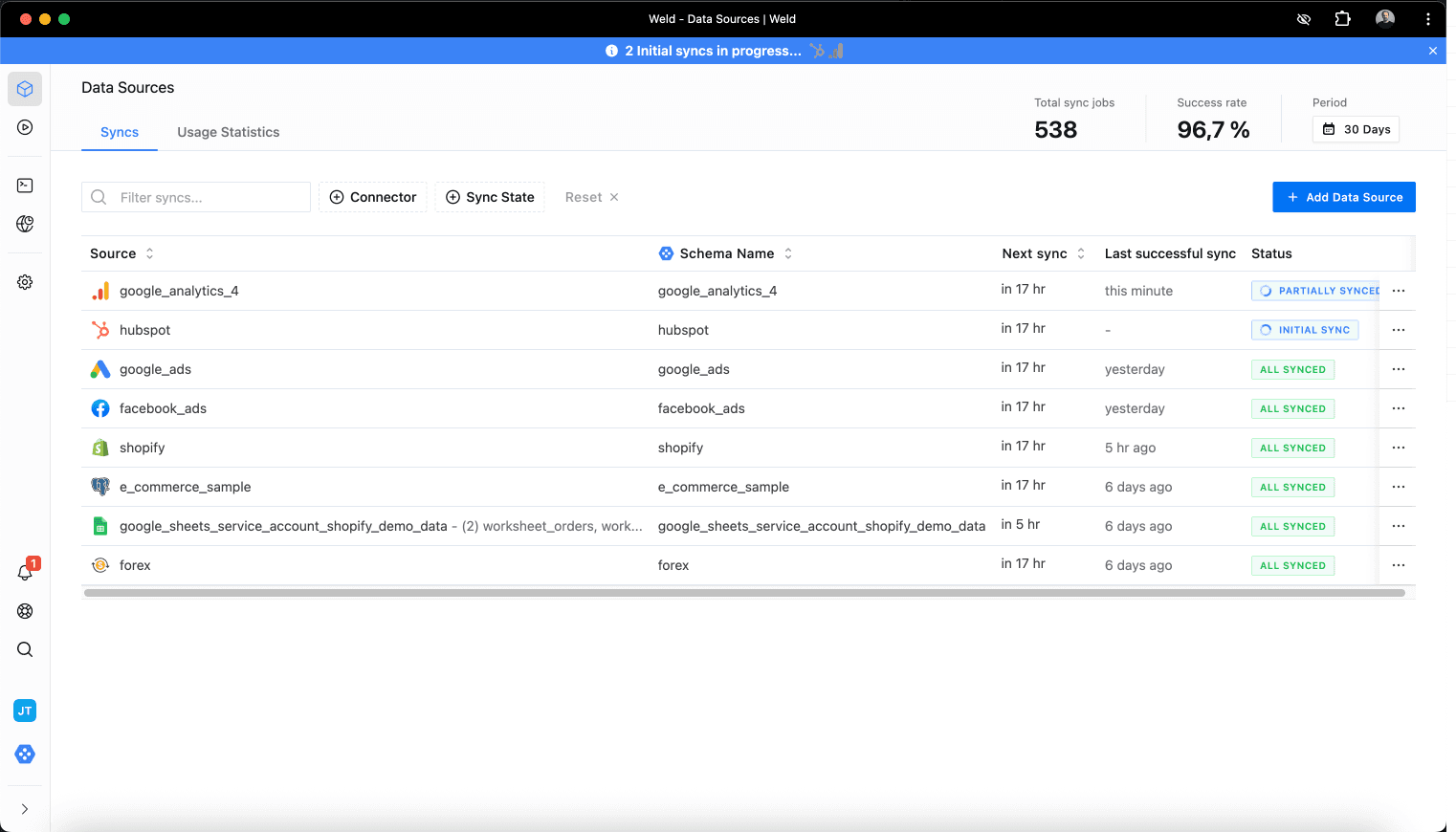
Weld is a unified ELT and data activation platform that combines ingestion, dbt-powered transformations, orchestration, lineage, and reverse ETL in a single SaaS interface. CDC is built into the platform for database sources, providing sub-minute sync without separate tooling.
CDC approach: Log-based CDC for supported database connectors (Postgres, MySQL, SQL Server, MongoDB). Changes are captured from transaction logs and delivered to your warehouse with sub-minute latency. CDC is part of the same platform as ELT and reverse ETL: no separate product or setup.
Connectors: 300+ in-house-built connectors
Pros:
- Near real-time sync with sub-minute latency
- Predictable subscription pricing (no per-row or per-GB surprises)
- User-friendly interface with minimal setup
- Agent-native Connect API and first-class dbt integration
Cons:
- Connector catalog is smaller than Fivetran or Airbyte
- Streaming latency is sub-minute, not sub-second like Estuary
- Cloud-only (no self-hosted option)
Pricing: Starts at $99/month for 5M active rows
Weld’s graphical interface is intuitive and easy to work with, even for teams with limited SQL experience. Its flexibility across sources—from databases to Google Sheets and APIs—made onboarding smooth, and performance across larger workloads was consistently strong. Support was responsive and helpful throughout our setup and ongoing use.
Reviews: G2 Reviews
Our take: Weld's CDC is best when you also need ELT and reverse ETL in the same platform. You avoid managing separate tools for ingestion, transformation, and activation. The trade-off is that streaming latency is sub-minute rather than sub-second, and the connector catalog is smaller than the largest platforms. Best for teams that want unified pipelines with real-time database sync.
Qlik Replicate: Best Enterprise Database Replication

Qlik Replicate (formerly Attunity Replicate) is a dedicated change data capture and replication platform. It moves data in real-time from databases, mainframes, and cloud sources into warehouses, data lakes, and analytics platforms.
CDC approach: Log-based CDC with minimal source impact. Supports a wide range of database sources including Oracle, SQL Server, DB2, SAP, MongoDB, and mainframe systems. Automated schema change handling and "read once, write many" replication to multiple targets simultaneously.
Connectors: 100+ (focused on databases and enterprise systems)
Pros:
- High-performance CDC with low impact on source systems
- Broad heterogeneous source support (mainframes, SAP, Oracle, DB2)
- Automated schema-change handling with minimal manual intervention
- GUI-based task configuration and monitoring dashboards
- "Read once, write many" fork to multiple targets
Cons:
- No ELT or complex transformation engine: replication only
- Enterprise licensing can be expensive
- Advanced replication scenarios require expertise
- No reverse ETL
Pricing: Custom enterprise licensing (subscription or perpetual)
Reviews: Gartner Reviews
Our take after testing: Qlik Replicate is the best choice for enterprise database replication, especially if you need CDC from Oracle, DB2, or mainframe sources. The "read once, write many" pattern is powerful for multi-target scenarios. But it is replication-only: you will need separate tools for transformation, orchestration, and activation. Best for large enterprises with complex source databases and dedicated data engineering teams.
Full comparison: Qlik Replicate vs Weld
Fivetran: Best CDC Within a Managed ELT Platform
Fivetran is the most widely used managed ELT platform, with 700+ prebuilt connectors. For database sources, Fivetran supports log-based CDC with automatic schema handling and incremental updates.
CDC approach: Log-based CDC for supported database connectors (Postgres, MySQL, SQL Server, Oracle, MongoDB, others). For SaaS connectors, Fivetran uses API-based incremental sync rather than CDC. CDC latency is typically in the minutes range, not real-time.
Connectors: 700+ (largest managed connector catalog)
Pros:
- Largest prebuilt connector library
- Log-based CDC for major databases
- Reverse ETL via Census integration
- Minimal maintenance and high reliability
- dbt integration for transformations
Cons:
- Usage-based pricing (MAR) can escalate quickly
- CDC latency is minutes, not sub-second
- Transformations require SQL and dbt expertise
- Reverse ETL is a separate product (Census)
Pricing: Usage-based, starting $500 for 1M MARs
Reviews: G2 Reviews
Our take after testing: Fivetran's CDC works well for database sources where minutes-latency is acceptable. The real strength is that CDC is part of a broader managed ELT platform with the largest connector catalog. The trade-off is pricing: MAR-based billing can surprise growing teams, and if you need sub-second latency, Fivetran is not the right tool. Best for teams already using Fivetran for ELT who also need database CDC.
Full comparison: Fivetran vs Weld
Airbyte: Best Open-Source CDC
Airbyte is the largest open-source data integration platform, with 600+ connectors. CDC support is provided through Debezium-based connectors for Postgres, MySQL, SQL Server, and MongoDB.
CDC approach: Debezium-based log reading for database sources. Self-hosted Airbyte gives you full CDC control; Airbyte Cloud provides managed CDC with plan-based pricing that has changed over time. CDC connectors run as containerized jobs and sync changes incrementally.
Connectors: 600+ (largest open-source catalog)
Pros:
- Free self-hosted option with full CDC support
- Debezium-based: proven, battle-tested CDC engine
- 600+ connectors (community + certified)
- Cloud option reduces operational burden
- Strong dbt integration
Cons:
- CDC connector quality varies (community-maintained)
- Self-hosted requires engineering for deployment and monitoring
- CDC latency is typically minutes (batch-oriented scheduling)
- Cloud pricing and packaging have changed multiple times
Pricing: Free (self-hosted) / Plan-based cloud pricing (see latest pricing page)
If you don't have workloads that currently use DBT or fit well into that model, this probably isn’t the tool for you.
Reviews: G2 Reviews
Our take after testing: Airbyte is the best open-source CDC option if you want self-hosted, free, and customizable. The Debezium foundation is solid. The trade-offs are operational: you need to manage deployment, monitoring, and connector maintenance yourself. Connector quality varies because many are community-contributed. Best for engineering teams that want full control and are comfortable running their own infrastructure.
Full comparison: Airbyte vs Weld
Qlik Talend Cloud: Best Enterprise CDC + ELT Suite
Qlik Talend Cloud combines data replication, change data capture, ELT pipelines, and data quality in a single enterprise suite. It is built for hybrid and multi-cloud environments, with support for cloud, on-prem, and lakehouse architectures.
CDC approach: Log-based CDC as part of the broader Talend data integration suite. CDC feeds into ELT pipelines with transformation capabilities. Supports near real-time replication across hybrid environments.
Connectors: 100+ (expanding, enterprise-focused)
Pros:
- Enterprise-grade CDC + ELT in one suite
- Strong replication + CDC for near real-time pipelines
- Built for hybrid and multi-cloud data movement
- Data quality and governance features in higher tiers
Cons:
- Best suited to experienced data teams
- Expensive for smaller companies
- Capacity + tier based pricing makes cost forecasting complex
- Some advanced capabilities locked to higher tiers
Pricing: Tiered subscription + capacity-based (custom quotes)
Reviews: Gartner Reviews
Our take after testing: Qlik Talend combines CDC, ELT, and data quality in a single enterprise suite. The platform depth is impressive for hybrid/multi-cloud scenarios. The complexity is real though: smaller teams will find the implementation heavy, and pricing is capacity-plus-tier based. Best for mature data teams migrating from on-prem to cloud with governance requirements.
Full comparison: Talend vs Weld
Informatica PowerCenter: Best Legacy Enterprise CDC
Informatica PowerCenter is the industry-standard enterprise ETL platform with decades of deployments. CDC is handled through PowerExchange, which reads database transaction logs and streams changes to PowerCenter workflows.
CDC approach: PowerExchange provides log-based CDC for Oracle, SQL Server, DB2, VSAM, IMS, and other enterprise sources. Changes are captured with minimal source impact and fed into PowerCenter's transformation engine.
Connectors: 200+ (including mainframe and legacy systems)
Pros:
- Highly scalable ETL engine with parallel processing
- PowerExchange CDC for enterprise and mainframe sources
- Comprehensive data quality, profiling, and governance
- Robust workflow orchestration with logging and recovery
- Broadest legacy source support (mainframe, SAP, Oracle, DB2)
Cons:
- High total cost of ownership (licensing + infrastructure + specialists)
- Dated UI compared to modern cloud-native tools
- Steep learning curve and long onboarding
- Less agile for rapidly evolving needs
Pricing: Enterprise licensing (typically six-figure annual contracts)
Informatica PowerCenter has been a classic, with decades in the industry. It offers every possible connector and provides robust mapping tools.
Reviews: Gartner Reviews
Our take after testing: Informatica is the enterprise heavyweight for a reason. PowerExchange CDC handles sources that most other tools cannot touch (mainframe, VSAM, IMS). The trade-off is cost and complexity: you need specialized skills, long implementation cycles, and enterprise budgets. Best for large organizations with legacy source systems and strict compliance needs.
Full comparison: Informatica PowerCenter vs Weld
AWS Glue: Best CDC on AWS
AWS Glue is a serverless ETL platform from AWS with streaming capabilities for CDC workloads. While not a dedicated CDC tool, Glue can consume CDC events from Kinesis Data Streams, Kafka (MSK), or DynamoDB Streams and process them using Spark Streaming.
CDC approach: Glue does not natively read database transaction logs. Instead, you pair it with AWS Database Migration Service (DMS) for log-based CDC, then Glue consumes the CDC events from S3, Kinesis, or Kafka for transformation and loading. This is a two-tool pattern: DMS captures, Glue transforms.
Connectors: 50+ (AWS-native services)
Pros:
- Serverless: no infrastructure to manage
- Deep integration with S3, Redshift, Athena, Kinesis, DMS
- Supports PySpark and Scala for complex transformations
- Glue Data Catalog provides schema discovery and metadata
Cons:
- CDC requires DMS as a separate service (not built-in)
- DPU-hour billing makes costs hard to predict
- Debugging PySpark jobs is painful
- Multi-cloud or on-prem sources need additional networking
Pricing: $0.44 per DPU-hour + job runtime costs
My team built a framework in AWS Glue to fetch data from multiple platforms and store it in S3 in the format we specified. It streamlined our integration and data collection.
Reviews: G2 Reviews
Our take after testing: AWS Glue is powerful for teams already on AWS, but it is not a standalone CDC tool. You need DMS for the actual change capture, then Glue for transformation and loading. This two-tool pattern adds complexity. Best for AWS-heavy stacks with data engineering capacity and existing DMS deployments.
Full comparison: AWS Glue vs Weld
CDC Patterns: When to Use What
Full table sync vs. CDC
| Approach | When to use | Latency | Cost |
|---|---|---|---|
| Full table sync | Small tables, infrequent changes, simple setup | High (minutes-hours) | Low compute, high data transfer |
| CDC (incremental) | Large tables, frequent changes, real-time needs | Low (seconds-minutes) | Lower data transfer, higher setup complexity |
For tables under 1M rows that change infrequently, full syncs are simpler and cheaper. For larger tables with continuous writes, CDC saves bandwidth and delivers fresher data.
CDC to warehouse vs. CDC to streaming
| Pattern | Tools | Use case |
|---|---|---|
| CDC to warehouse | Weld, Fivetran, Airbyte, Qlik Talend | Analytics, BI, reporting |
| CDC to Kafka/event bus | Estuary, Qlik Replicate, DMS + Glue | Microservices, event-driven apps, real-time ML |
| CDC to multiple targets | Qlik Replicate, Estuary | Data mesh, multi-consumer architectures |
When you do NOT need CDC
- Your source is a SaaS API (no transaction log): use API-based ELT instead
- Data freshness requirements are hourly or daily: scheduled batch sync is simpler
- You are syncing fewer than 10 tables with low volume: full syncs are fine
- You need data from files, spreadsheets, or webhooks: these have no transaction logs
CDC in an Agentic Stack
CDC becomes more valuable in an agentic stack because agents are only as useful as the freshness and reliability of the data they can act on. If an agent is generating alerts, updating CRM records, or triggering downstream workflows from warehouse models, stale batch syncs often create the wrong action at the wrong time.
The most agent-ready CDC setups usually have these traits:
- Low-latency delivery: The warehouse or downstream system gets changes fast enough for the agent to act on current state.
- Observable sync state: Agents or automation can inspect whether a replication job is healthy before making decisions.
- Deterministic modeling layer: dbt or SQL transformations turn raw CDC streams into trusted business entities the agent can use safely.
- Controlled downstream activation: Reverse ETL, webhooks, or APIs let the agent move from insight to action without manual exports.
In practice, that means different tools fit different agent workflows:
- Estuary: best when the agent depends on streaming or event-driven architectures.
- Weld: best when the agent needs CDC plus dbt-backed models and activation in the same managed workflow.
- Qlik Replicate: best when the hard part is enterprise-grade replication from complex source systems.
- Airbyte and Debezium-based stacks: best for engineering teams building custom agent pipelines around open infrastructure.
Common Mistakes with CDC
-
Using CDC when batch sync is sufficient. CDC adds complexity. If hourly freshness is fine, scheduled syncs are simpler and cheaper.
-
Forgetting about deletes. Not all CDC implementations capture hard deletes reliably. Verify that your tool handles deletes, not just inserts and updates.
-
Ignoring schema drift. Source schemas change. Tools like Estuary and Qlik Replicate handle schema evolution automatically. Others may break on column additions or type changes.
-
Underestimating CDC costs at scale. Usage-based pricing (per-GB or per-row) can spike with high-change-rate tables. Model your costs before committing.
-
Skipping initial load planning. CDC captures changes going forward. You still need an initial full load, and large tables can take hours. Plan for this.
CDC FAQs
What is the difference between CDC and ETL?
ETL extracts full datasets, transforms them, and loads them into a target. CDC captures only the changes (inserts, updates, deletes) from a source database and replicates them incrementally. CDC is a subset of ETL: it handles the "extract" step more efficiently for database sources with frequent changes.
What is the best free CDC tool?
Airbyte (self-hosted) provides free CDC through Debezium-based connectors for Postgres, MySQL, SQL Server, and MongoDB. For standalone CDC, Debezium itself is free and open-source but requires Kafka infrastructure.
Do I need Kafka for CDC?
Not necessarily. Tools like Estuary, Weld, Fivetran, and Airbyte handle CDC without exposing Kafka to the user. If you are building event-driven microservices or need a persistent event log, Kafka (or Redpanda) plus Debezium is the standard open-source pattern.
Can I use CDC with SaaS sources?
SaaS tools (HubSpot, Stripe, Shopify) do not expose transaction logs. CDC in the traditional sense does not apply. Instead, ELT tools use API-based incremental sync (polling for changes via API endpoints). Some tools call this "CDC" in marketing, but it is technically API-based incremental replication.
What is the fastest CDC tool?
Estuary Flow claims sub-second latency for streaming CDC. Qlik Replicate delivers seconds-level latency for database replication. Weld provides sub-minute CDC. Fivetran and Airbyte typically deliver CDC changes in minutes due to batch-oriented scheduling.
What is the best CDC tool for AI agents?
The best CDC tool for AI agents depends on what the agent needs to do after replication. If the agent depends on sub-second or event-stream behavior, Estuary is the strongest fit. If the agent needs fresh warehouse data plus transformations and downstream activation in one workflow, Weld is the most complete managed option in this list. If the team is building a custom event-driven platform with Kafka-compatible infrastructure, Debezium or Airbyte can be a better fit because engineers can control more of the pipeline directly.
Can AI agents safely trigger CDC-driven workflows?
Yes, but only when the pipeline exposes health, permissions, and auditability. Agents should not blindly trigger actions from raw CDC streams. The safer pattern is: replicate changes, transform them into trusted models, verify the sync completed successfully, and only then let the agent trigger downstream actions such as alerts, CRM updates, or warehouse-to-SaaS syncs.
Related Guides
- Top 15 Best ETL Tools in 2026: Hands-on reviews of the top ETL and ELT platforms
- Every ETL Tool in 2026: 50+ Platforms Compared: Complete comparison of every ETL, ELT, and CDC tool
- ETL vs ELT: What is the Difference?: Deep dive into the two approaches
- What is Reverse ETL?: How data activation works
Sources (Vendor Pages)
- Estuary: Pricing, Connector docs
- Weld: Pricing, CDC docs, API reference
- Qlik Replicate: Product page
- Fivetran: Pricing, Connector docs
- Airbyte: Pricing, Connectors, Docs
- Qlik Talend: Product, Talend Data Fabric
- Informatica: Cloud integration product, Pricing
- AWS Glue: Pricing, Docs
Last verified: May 9, 2026.