
Choosing the Right Data Warehouse for Your Analytics Strategy
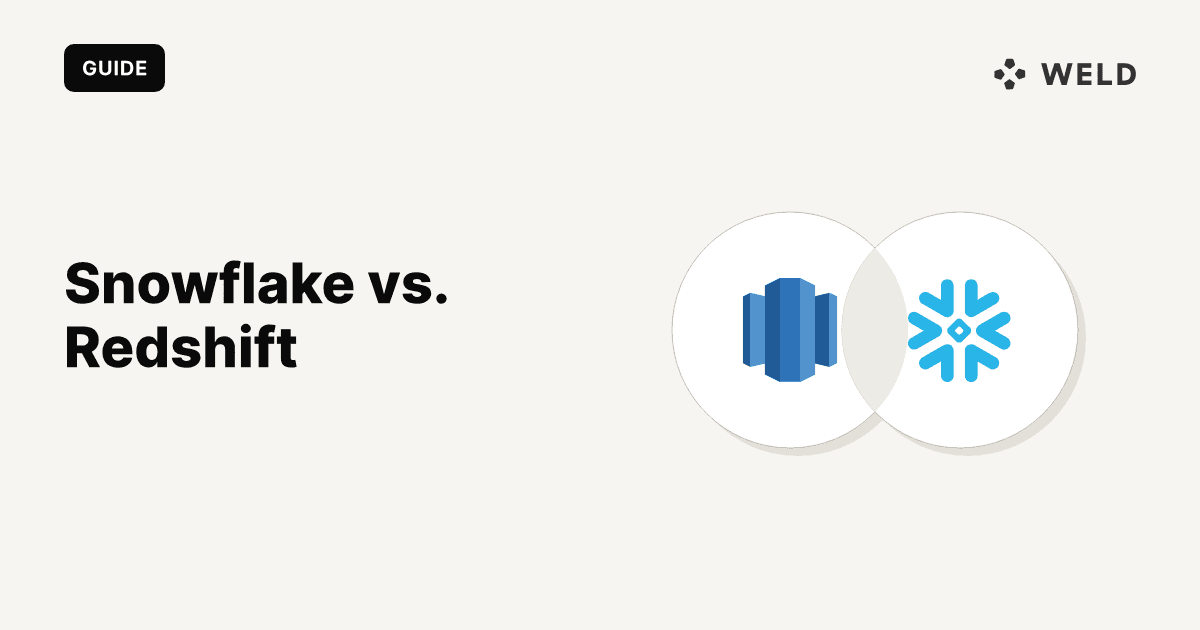
One popular topic among data teams is choosing the right data warehouse, specifically: Redshift vs. Snowflake.
Data teams often face a central question: Which data warehouse best fits my analytics strategy? Here's a practical comparison between Amazon Redshift and Snowflake, two of the most widely adopted options today.
Architecture & Scaling
Snowflake decouples compute and storage with automatic, near-instant scalability. You can spin up independent virtual warehouses for different workloads, scale them up or down on demand, and pause them when idle and all without moving any data.
Redshift bundles compute and storage together (though RA3 nodes offer some separation via managed storage). Scaling requires manual intervention and can take minutes, making it better suited to stable, predictable workloads.
Snowflake wins on elasticity; Redshift wins on simplicity for steady workloads.
Pricing Models
Snowflake separates compute from storage and bills pay-as-you-go by the second, offering granular control over costs. Great for bursty or variable workloads, but can become expensive if warehouses are left running unnecessarily.
Redshift pricing combines compute + storage per node. It's often more predictable, especially with reserved instance commitments (up to 75% savings over 1–3 years). Redshift Serverless is also available for teams that want flexibility without managing clusters.
Snowflake offers flexibility; Redshift rewards commitment with lower costs.
Semi-Structured Data
Snowflake has robust native support for JSON, Avro, Parquet, and other semi-structured formats via its VARIANT data type. Querying nested data is intuitive and requires no preprocessing.
Redshift can handle semi-structured data through SUPER data types and Redshift Spectrum, but often needs extra steps or tooling to work with complex nested structures at scale.
Snowflake is the clear winner for teams working heavily with JSON or semi-structured data.
Automation & Maintenance
Snowflake automates the majority of maintenance tasks, meaning no manual vacuuming, no compression tuning, no index management. This translates to a lower operational burden for your data team.
Redshift may require manual tuning such as running VACUUM and ANALYZE commands, managing distribution and sort keys, and monitoring WLM (Workload Management) queues. Newer features have reduced this burden, but it still requires more DBA involvement.
Snowflake is lower-maintenance; Redshift gives more control for teams that want it.
Ecosystem & Integrations
Snowflake offers broad integrations across clouds (AWS, Azure, GCP) and a rich ecosystem of BI tools, ETL platforms, and data exchange partnerships via the Snowflake Marketplace. It also supports Snowpark for running Python, Java, and Scala natively.
Redshift integrates deeply with the AWS ecosystem including Athena, DynamoDB, CloudWatch, Glue, SageMaker, and QuickSight, making it a natural fit for teams already operating within AWS.
Snowflake for multi-cloud and broad tooling; Redshift for AWS-native stacks.
When to Choose What?
Choose Redshift: strong choice if you're heavily invested in the AWS ecosystem and want predictable pricing and control.
Choose Snowflake: ideal if you want elastic auto-scaling, flexible workload sharing, and modern tooling with minimal maintenance.
Conclusion
| Category | Amazon Redshift | Snowflake |
|---|---|---|
| Best Fit | AWS-centric environments with stable workloads | Multi-cloud environments with dynamic or variable workloads |
| Scaling Strategy | More manual, better for predictable usage | Fully elastic, automatic scaling |
| Cost Model | Predictable pricing, especially with reserved instances | Pay-as-you-go, flexible but requires cost monitoring |
| Maintenance | More control, requires tuning and DBA involvement | Minimal maintenance, highly automated |
| Semi-Structured Data | Supported but may require extra steps | Native and seamless support (e.g., VARIANT) |
| Ecosystem | Deep integration with AWS services | Broad integrations across AWS, Azure, GCP, and partner ecosystem |
| AI / ML Capabilities | Strong via AWS ecosystem (e.g., SageMaker, Glue ML, external integrations) | Built-in support via Snowpark (Python, Java, Scala) and growing native AI/ML capabilities |
| When to Choose | When you need cost predictability and are already invested in AWS | When you need flexibility, scalability, and minimal operational overhead |
| Overall Strength | Control, cost efficiency, AWS-native workflows | Flexibility, ease of use, and modern data platform features |
Both are powerful platforms, and the best option often comes down to your cloud strategy, workload patterns, and team expertise.
- Already all-in on AWS? Redshift's deep integrations and predictable cost model make it compelling.
- Need multi-cloud flexibility and hands-off scaling? Snowflake is hard to beat.