
Fivetran is one of the most well-known data integration platforms, offering automated ELT pipelines to sync data from hundreds of sources into cloud data warehouses. But understanding what you'll actually pay is harder than it should be.
Fivetran uses a usage-based pricing model built around Monthly Active Rows (MAR), which means your bill depends on how much data changes each month. In 2025 and 2026, Fivetran rolled out several pricing changes that made this model more complex, and for many teams, more expensive. You can see the tier overview on Fivetran's pricing page.
This article breaks down how Fivetran pricing actually works in 2026, what changed, what the hidden cost drivers are, and how it compares to alternatives.
How Fivetran pricing works
Fivetran charges based on Monthly Active Rows (MAR), the number of distinct rows inserted, updated, or deleted across your data sources in a given month.
Here's how MAR counting works:
- A row is counted once per month, even if it's updated multiple times.
- Inserts, updates, and deletes all count toward paid MAR (deletes were added in 2026).
- Each connection is billed separately. MAR is calculated per connection, not across your account.
- Initial syncs are free. Historical data loaded during the first sync doesn't count.
- Re-syncs of unchanged rows are free. Only actual data changes are billed.
- A $5 monthly minimum applies to every connection generating between 1 and 1M MAR (added January 2026). A connection whose usage would cost less is billed $5.
The per-MAR cost decreases as volume increases, following a consumption curve published in Fivetran's service consumption table. Critically, this volume discount applies per connection, not across your account -- a change from 2025 that significantly affects teams with many connectors.
Fivetran also has two additional consumption meters beyond connections:
- Transformations are billed in Monthly Model Runs (MMR) on a separate curve.
- Activations (reverse ETL) use their own MAR consumption curve per activation destination.
This means Fivetran is effectively three billing meters in one platform: connection MAR, activation MAR, and transformation MMR.
Fivetran pricing plans
Fivetran offers four tiers. All use the same MAR-based billing, but the tier determines which features you can access.
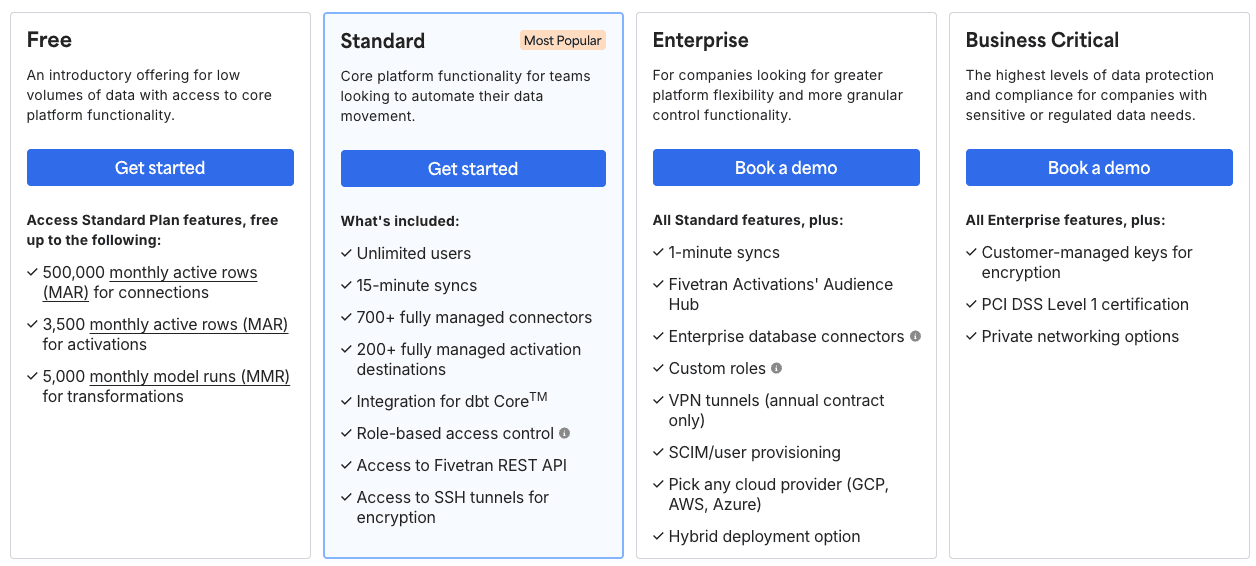
| Free | Standard | Enterprise | Business Critical | |
|---|---|---|---|---|
| MAR limit | 500K | Unlimited (pay-per-use) | Unlimited (pay-per-use) | Unlimited (pay-per-use) |
| Sync frequency | 15 minutes | 1 minute | 1 minute | |
| Connectors | 700+ | 700+ | 700+ + enterprise DB | 700+ + enterprise DB |
| Activations (reverse ETL) | 3,500 MAR | Usage-based | Usage-based | Usage-based |
| Transformations | 5,000 runs/mo | 5,000 free, then pay-per-run | 5,000 free, then pay-per-run | 5,000 free, then pay-per-run |
| Key features | Core platform | RBAC, REST API, SSH | Custom roles, VPN, SCIM, hybrid deploy | Customer-managed keys, PCI DSS L1, private networking |
Annual contracts get discounts starting at 5% and going up to 22%+ at larger commitments. However, annual contracts auto-renew for successive one-year periods at the then-current order form price, so read the terms carefully.
Fivetran can also be purchased through AWS, GCP, and Azure marketplaces. GCP marketplace only supports Standard and Enterprise plans, and none of the cloud marketplaces support starting a trial.
Transformation pricing
Transformation pricing is the most transparent part of Fivetran's billing:
| Monthly model runs | Price per run |
|---|---|
| First 5,000 | Free |
| 5,001--30,000 | $0.01 |
| 30,001--100,000 | $0.007 |
| 100,000+ | $0.002 |
Activation pricing
Activations (reverse ETL) use MAR billed on a separate consumption curve per activation. Fivetran's published examples show Standard plan costs of roughly $198--$202/month for around 10K--12K activation MAR. An Enterprise example from Fivetran's service consumption table shows 15,000 activation MAR costing approximately $479/month. Activations can become expensive at relatively low volumes, especially for teams that only think in terms of classic ELT costs.
Enterprise License Agreements (ELAs)
For larger organizations, Fivetran offers ELAs: fixed annual prices with no consumption ceiling. ELAs target two customer profiles:
- Entire workload customers who want to move all integration work to Fivetran, priced using target prices based on company size and workload factors.
- Predictability customers who want budget certainty, priced at a premium over the estimated usage-based cost.
ELAs are only available "under specific circumstances," meaning the largest customers often end up outside the simple self-serve pricing logic entirely.
What is Monthly Active Rows (MAR)?
MAR is Fivetran's unit of measurement for data volume. It counts the number of distinct primary keys that change in your source systems each month.
How MAR billing works, step by step
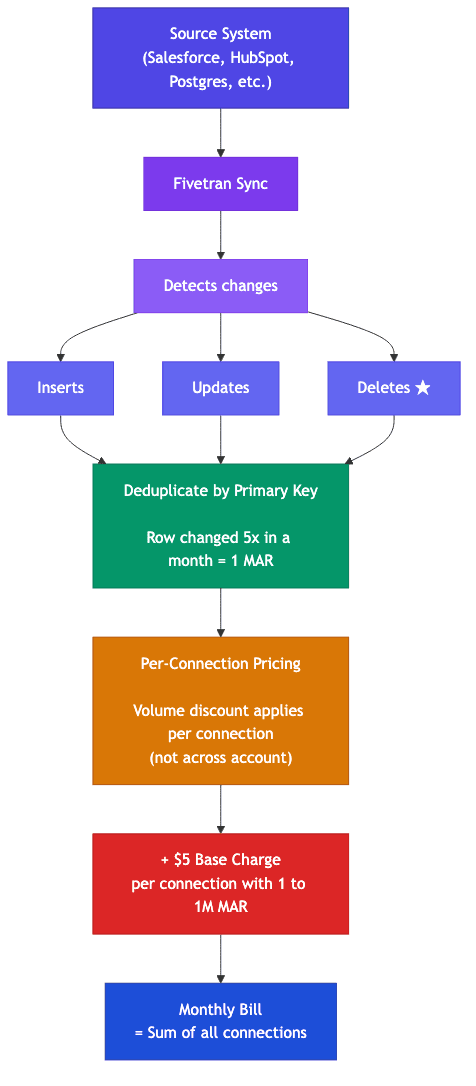
Key rules:
- A row is counted if it is inserted, updated, or deleted.
- A row is only counted once per month, regardless of how many times it changes.
- MAR resets every month. A row updated this month will count again if it changes next month.
- Deleted rows count as MAR since January 2026.
- History mode tracks repeated updates, and each update now counts toward paid MAR.
MAR is calculated per connection. If you sync the same source to two destinations, both connections contribute separately to your MAR total.
For the full consumption curve and pricing formulas, see Fivetran's official pricing documentation and the Service Consumption Table.
What changed in 2025 and 2026
Fivetran has made several pricing changes over the past two years that affect most customers.
2020: Shift from connection-based to usage-based pricing
Fivetran originally charged per connection. In 2020, they migrated to usage-based MAR pricing, treating it as a fairer model where you only pay for data that actually changes.
March 2025: Per-connection MAR billing
Previously, MAR was calculated across your entire account, letting companies spread usage across connections and benefit from aggregate volume discounts. Since March 2025, each connection has its own MAR count and pricing curve. This increased costs significantly for teams running many connectors with moderate volumes each.
Other March 2025 changes:
- Re-synced identical rows no longer count toward MAR
- Free re-sync scenarios expanded (historical data from adding columns, unchanged rows in re-import tables)
January 2026: Three new charges
-
$5 minimum connection charge. Every connection generating between 1 and 1M MAR is now billed at least $5 a month. Fivetran calls it a base charge, but it works as a minimum: a connection whose usage already costs more than $5 pays nothing extra. At about $500 per million MAR, that means connections under roughly 10,000 MAR. Connections with zero MAR or over 1M MAR are unaffected, and it doesn't apply to the Free plan.
-
Deletes count toward paid MAR. Previously, deleting a row in your source didn't count as usage. Now deletes are treated like any other change. A row deleted twice in a month still only counts once.
-
History mode rows are billed. If you use history mode (which tracks every change to a row over time), repeated updates within a month now count toward paid MAR. Previously, only the first change was billed.
February 2026: Activations (reverse ETL)
Fivetran now offers Activations (formerly Census), adding reverse ETL to the platform. Activations are billed separately using their own MAR consumption curve. The Free plan allows 3,500 activation MAR/month.
What to watch out for when budgeting
Fivetran's usage-based model makes budgeting harder than fixed-price plans. Here are the most common cost surprises data teams report:
- Seasonal data spikes. Marketing campaigns, Black Friday, or end-of-quarter reporting can push MAR significantly higher.
- Multiple connections to the same source. Syncing Salesforce to staging and production counts as two connections with separate MAR.
- Connection-level tiering impact. With many sub-1M-MAR connections, you lose the benefit of aggregate volume discounts. Each connection starts at the top of its own consumption curve.
- Ad reporting connectors. Adding a new ad account to an existing connection may trigger historical syncs that spike MAR.
- History mode. If enabled, every tracked change counts toward MAR. High-frequency sources like event tables can generate substantial usage.
- The $5 minimum adds up on small connections. 20 low-volume connections, each using less than $5 of MAR, cost $100 a month in minimums.
- Activations and Transformations are separate meters. Budget for three consumption curves, not one.
- Difficult to audit. User reviews consistently cite challenges in understanding why bills increased and difficulty tracing MAR changes back to specific connections.
What does Fivetran actually cost? Three examples
Fivetran does not publish a single price. To make things concrete, here are three illustrative cost scenarios based on Fivetran's published connector examples and consumption model.
These estimates assume Standard plan pricing with the connection-level consumption curve applied per connection.
| Scenario | Connections | MAR per connection | Activations | Transformations | Estimated monthly cost |
|---|---|---|---|---|---|
| Small team | 4 connectors | ~50K MAR each | 1 activation (~$200) | 10K MMR | ~$370/mo |
| Mid-size team | 12 connectors | ~250K MAR each | 2 activations (~$400) | 40K MMR | ~$2,280/mo |
| Enterprise | 40 connectors | ~800K MAR each | 8 activations (~$3,800) | 250K MMR | ~$21,000/mo |
The key takeaway is not the specific numbers, but the structure. With many sub-1M connections, connection-level tiering makes costs significantly higher than most teams intuitively expect, because volume is not aggregated into one large discount curve. This is precisely why Fivetran's own ELA pitch around "predictability" resonates with larger customers.
Fivetran alternatives: pricing comparison
Fivetran is strongest on connector maturity, managed reliability, and enterprise governance. But competitors often offer simpler pricing models, lower entry prices, or open-source flexibility.
| Platform | Pricing model | Starting price | Key difference vs. Fivetran |
|---|---|---|---|
| Weld | Fixed tiers with included MAR | $99/mo, billed annually | Predictable flat rate. Connectors, MAR, transformations, and reverse ETL all included. |
| Stitch | Row-based per month | $100/mo | Simpler public pricing with row bundles. Fewer governance features. |
| Airbyte | Credits on Standard and Plus, capacity on Pro and Enterprise Flex | $20/mo | Open source option. Low entry price. Less unified commercial model. |
| Hevo Data | Event tiers | $299/mo ($265/mo billed annually) | Simple event-based tiers. Updates and deletes count as events, much like MAR. |
| Matillion | Credit-based | Not publicly listed | Credit model based on task hours. Strong transformation story. Low pricing transparency. |
Who should consider switching?
- Teams with many connectors and variable data volumes often find Fivetran's per-connection MAR model expensive and hard to budget. A fixed-tier model (like Weld) provides predictability.
- Teams that need reverse ETL bundled rather than billed as a separate meter should look at platforms that include it in the base price.
- Smaller teams evaluating Stitch or Airbyte can get started at a lower price point, but should evaluate governance, reliability, and long-term scaling costs.
Fivetran vs. Weld: a detailed pricing comparison
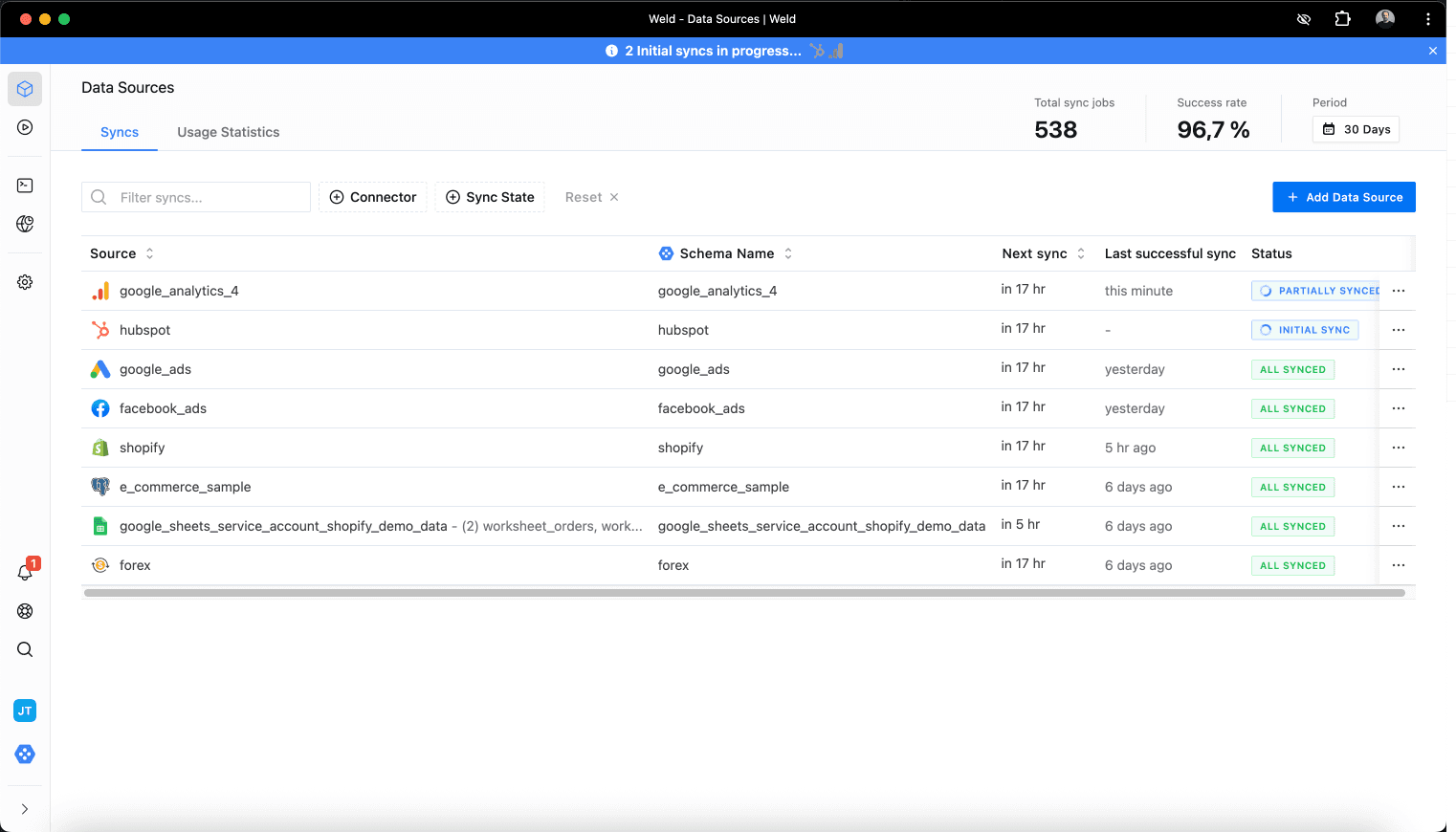
Weld takes a different approach to pricing. Instead of pure pay-per-row billing, Weld uses fixed-tier pricing with included MAR, connectors, and users. Your bill stays predictable month to month.
| Fivetran (Standard) | Weld (Premium) | Weld (Business) | |
|---|---|---|---|
| Pricing model | Pay-per-MAR per connection | Fixed tier with included MAR | Fixed tier with included MAR |
| Starting price | ~$549/mo (4 connectors, median usage) | $389/mo, billed annually | $959/mo, billed annually |
| Connectors included | Unlimited (but each adds MAR cost) | 6 (+$99/mo each, up to 2 more) | 10 (+$99/mo per extra) |
| MAR included | None (all usage is billed) | 10M (+$99/mo per +10M) | 50M (+$479/mo per +50M) |
| Sync frequency | 15 minutes | 1 hour (30-min add-on, +$99/mo) | 15 minutes (5-min add-on, +$99/mo) |
| Users | Unlimited | 3 (+$19/mo per extra) | 5 (+$19/mo per extra) |
| Destinations | 1 | 1 | Multiple |
| Transformations | 5,000 free runs, then pay-per-run | AI SQL Editor + dbt included | AI SQL Editor + dbt included |
| Reverse ETL | Activations (separate MAR billing) | Included | Included |
| REST API | Included | Included | Included |
| Free trial | Free plan (500K MAR cap) | 14-day full-access trial | 14-day full-access trial |
Which pricing model works better?
Fivetran's MAR-based pricing can work well for teams with low, stable data volumes where you only pay for what changes. But costs become unpredictable as you add connections, deal with seasonal spikes, or enable features like history mode. The per-connection billing, $5 per-connection minimum, and three separate consumption meters add up quickly.
Weld's fixed-tier pricing is designed for teams that want to know what they'll pay each month. You get a set number of connectors and MAR included in your plan, with clear overage pricing. There are no per-connection minimums, no separate transformation billing, and reverse ETL is included rather than billed as a separate product.
For companies syncing 5 to 10+ data sources, especially in marketing, e-commerce, and SaaS, Weld's flat-rate model is typically more cost-effective and easier to budget for.
What real users say about Fivetran pricing
User reviews on G2 and discussions on Reddit consistently highlight three pricing pain points:
- Unpredictable MAR exposure. One Reddit user in r/dataengineering reported "a huge spike (more than double)" in monthly costs after the 2025/2026 pricing changes. Another described MAR pricing producing a "monthly bill MUCH larger than expected" from a mis-configured connection running for just a few days.
- Opaque pricing and unexpected charges. G2 reviewers consistently call Fivetran "quite expensive" at scale and cite "opaque pricing and unexpected charges" in budget planning.
- Strong product, hard to budget. The consensus is that Fivetran delivers on reliability and connector quality, but the pricing model rewards specific workload patterns (few large, stable sources) and penalizes others (many connectors, frequent deletes, history mode, seasonal spikes).
The bottom line: Fivetran's "pain" is rarely the base price alone. It's the combination of hard-to-audit consumption logic, connection-level tiering, and changes to what counts as paid activity.
Frequently asked questions
How much does Fivetran cost per month?
Fivetran's cost depends entirely on your data volume (MAR), number of connections, activations, and transformation runs. Their published example shows ~$549/month for 4 connectors on the Standard plan at median usage. Real-world costs range from a few hundred dollars to $20,000+ per month for enterprise setups.
Does Fivetran have a free plan?
Yes. Fivetran's Free plan includes 500,000 MAR for connections, 3,500 MAR for activations, and 5,000 monthly model runs for transformations. If you exceed the Free plan limits in two months within a 12-month period, you become ineligible for the Free plan.
What is Fivetran MAR?
Monthly Active Rows (MAR) is the number of distinct primary keys that are inserted, updated, or deleted in your connected sources during a calendar month. Each row is counted once per month, even if it changes multiple times. MAR is counted per connection, not across your entire account.
Does Fivetran charge for deletes?
Yes, as of January 2026. Deleted rows in your source now count toward paid MAR, just like inserts and updates. A row deleted multiple times in the same month still counts as one MAR.
Is Fivetran more expensive than Weld?
It depends on your usage. For teams with many connectors or variable data volumes, Fivetran's per-connection MAR billing often results in higher and less predictable costs. Weld's fixed-tier plans include connectors, MAR, transformations, and reverse ETL at a flat monthly rate, making budgeting simpler.
Does Fivetran charge for initial data loads?
No. Initial syncs (the first time a connection loads historical data) are free. However, any incremental data changes detected after the initial sync period will count toward paid MAR.
Does Fivetran offer annual discounts?
Yes. Annual contracts start at 5% off and scale up to 22%+ at larger commitments. Fivetran also offers discounts for non-profits, "Powered by Fivetran" customers, and sharded databases, plus a startup offer for Y Combinator companies providing up to $50K in free Fivetran credits.
Can I buy Fivetran through a cloud marketplace?
Yes. Fivetran is available through AWS, GCP, and Azure marketplaces with monthly pay-as-you-go billing. GCP only supports Standard and Enterprise plans, and no marketplace supports starting a trial. Azure does not support auto-renewal for Fivetran, even if the toggle is visible.
Final thoughts
Fivetran is a powerful data integration platform with a massive connector library and strong enterprise governance. But its pricing model has become more complex with each update. Connection-level MAR billing (2025), $5 per-connection minimums, delete billing, history mode charges (2026), and three separate consumption meters all add layers of cost that can be hard to predict.
The real question is not "is Fivetran expensive?" but "does Fivetran's pricing model fit your workload?" Teams with few large, stable data sources and strong cost governance can find good ROI. Teams with many connectors, frequent deletes, history tables, or weak usage monitoring risk significantly higher spend than initially estimated.
For teams that prefer cost predictability and want transformations, reverse ETL, and a clear pricing structure included out of the box, Weld offers a compelling alternative.
Additional resources
- Compare Fivetran vs. Weld
- Top Fivetran alternatives
- Weld as a Fivetran alternative
- Compare data tools with Weld
- Fivetran's 2026 pricing update FAQ