
Fivetran and Airbyte are the two names most teams shortlist when they want data from SaaS apps and databases in a warehouse. Both list 700+ connectors. The difference is in how they run and how they bill: Fivetran is a fully managed service priced by monthly active rows on each connection, while Airbyte can be self-hosted for free or used as a cloud service priced in credits.
Both have also changed a lot since 2025. Fivetran now bills every connection on its own curve, counts deletes, owns Census and has merged with dbt Labs. Airbyte has new plans built on credits and capacity. This guide compares them as they are today.
The short answer. Pick Fivetran if you want the least to run and can live with a bill that grows with every connection. Pick Airbyte Cloud if you want the same connectors for less and can accept more variation in connector quality. Pick self-hosted Airbyte if you have engineers who would rather run infrastructure than pay a vendor. If you want ingestion, transformations and reverse ETL on one flat bill, look at Weld too.
How we compared them. Prices and plan details come from Fivetran's pricing page and Airbyte's pricing page, checked on 7 November 2026. Where a vendor publishes no price, we say so. Weld is our product, and it competes with both.
Fivetran vs Airbyte at a glance
| Fivetran | Airbyte | |
|---|---|---|
| What it is | Fully managed ELT service | ELT platform, self-hosted or cloud |
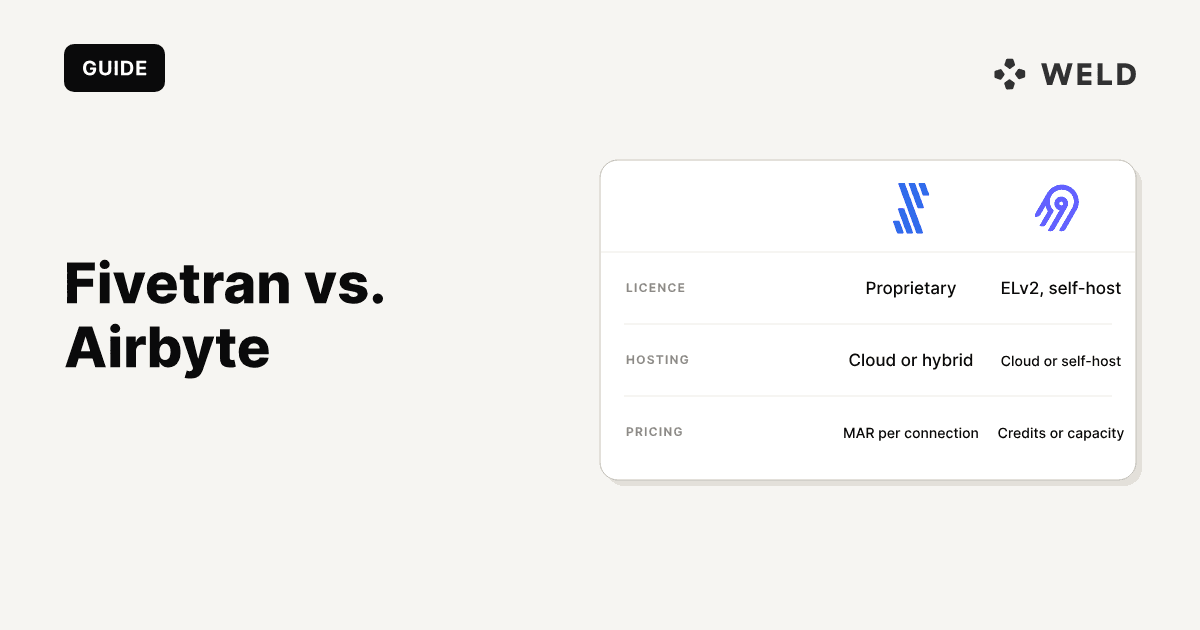
| Licence | Proprietary | Core under the Elastic License 2.0 |
| Connectors | 700+, built by Fivetran | 700+, Airbyte-maintained plus community |
| Deployment | Cloud, or hybrid on Enterprise | Cloud, self-hosted Core, or hybrid on Enterprise Flex |
| Pricing model | Monthly active rows (MAR) per connection | Credits by data synced, or capacity on Pro and Enterprise Flex |
| Free option | Free plan up to 500,000 MAR a month | Core is free to self-host; 14-day cloud trial with 400 credits |
| Entry price | Usage based; $5 base charge per Standard connection | $20/mo (Standard, 5 credits, about 1 GB) |
| Fastest sync | 15 minutes on Standard, 1 minute on Enterprise | Hourly on Standard, 15 minutes on Plus, 5 minutes on Pro |
| Transformations | dbt Core integration, 5,000 model runs a month free | Not built in; can trigger a dbt Cloud job after a sync |
| Reverse ETL | Activations (formerly Census), billed on its own MAR curve | Data activation to destinations such as HubSpot, Braze and Customer.io |
| Custom connectors | Connector SDK in Python | Connector Builder and CDK |
What changed since 2025
If you last compared the two a year or more ago, these are the changes that matter:
- March 2025: Fivetran started pricing MAR per connection, so each connection has its own volume curve and ten small connections cost more than one large one with the same total rows.
- May 2025: Fivetran agreed to acquire Census. It is now sold as Fivetran Activations, and since February 2026 it is billed on MAR like the rest of Fivetran.
- 2025: Fivetran acquired Tobiko Data, the company behind SQLMesh.
- January 2026: every Standard connection with any usage carries a $5 base charge, and deletes count as billable rows.
- 1 June 2026: Fivetran and dbt Labs completed their merger.
- Airbyte's plans are now Standard, Plus, Pro and Enterprise Flex. Standard and Plus are priced in credits; Pro and Enterprise Flex are quoted on capacity, measured in Data Workers.
How the pricing works
The two vendors don't just charge different amounts. They count different things.

Fivetran bills monthly active rows: every distinct row inserted, updated or deleted in your destination in a calendar month counts once, however often it changes. Unchanged rows from re-syncs don't count, and neither does the initial load when you set up a connection. Each connection is priced on its own curve, Standard connections with any usage cost at least $5 a month, and the per-row rate isn't published. Transformations and Activations are metered separately: 5,000 model runs a month are free, then from $0.01 per run.
Airbyte Cloud bills credits for the data its syncs move. Standard includes 5 credits for $20 a month, which Airbyte puts at about 1 GB of syncs. Plus starts at $189 a month for 40 credits and goes up in packages to $4,999 for 2,000 credits. How much data a credit covers depends on the source type, and every sync is metered, including the first full load. Pro and Enterprise Flex are priced on capacity instead of volume.
Self-hosted Airbyte Core has no licence fee. You pay for the servers and for the people who run them.
The practical consequence: rows that change often but rarely move in bulk are relatively cheap on Fivetran, because a row counts once a month. Large tables you reload or sync often are relatively cheap per row on Airbyte, but the volume adds up with every sync.
What it costs: two worked examples
Prices below are monthly list prices from each vendor's pricing page, checked 7 November 2026. The Airbyte figures assume about 1 KB per record and use Airbyte's own ratio of roughly 4 to 5 credits per GB. Your real numbers depend on row size, sync frequency and how often rows change.
Example 1: four marketing sources, about 1 million rows a month. This is Fivetran's own worked example: Facebook Ads (34,479 MAR), Google Analytics 4 (21,993), Marketo (847,574) and Google Ads (88,240).
| Monthly list price | Notes | |
|---|---|---|
| Fivetran Standard | $511.15 | Fivetran's own estimate for a company with 1 to 200 employees |
| Airbyte Cloud Standard | about $20 | About 1 GB moved once a month; frequent syncs of changing rows add volume |
| Weld Premium | $389, billed yearly | 6 connectors, 10M MAR, hourly syncs, reverse ETL included |
Example 2: five sources, 10 million rows a month, hourly or faster.
| Monthly list price | Notes | |
|---|---|---|
| Fivetran Standard | several thousand dollars | Fivetran's examples work out at roughly $500 per million MAR before volume discounts; see our Fivetran pricing breakdown |
| Airbyte Cloud Plus | $189 to $449 | About 10 GB is 40 to 50 credits: the 40-credit package or the 100-credit package for headroom, with 15-minute syncs |
| Weld Premium | $389, billed yearly | 10M MAR included, hourly syncs |
At small volume Airbyte is much cheaper than Fivetran on list price. The gap narrows when rows change many times a month and you sync often, and it moves the other way if you count the engineering time that a self-hosted setup needs.
Who runs what
The other half of the cost is work. Fivetran and Airbyte Cloud run the pipelines for you; self-hosted Airbyte hands that work to your team.

Connector quality. Fivetran builds and maintains its connectors itself. Airbyte's catalogue mixes connectors Airbyte maintains with community-contributed ones from its Marketplace, so check who maintains each connector you depend on before you choose.
Licence. Airbyte Core is free to use and modify under the Elastic License 2.0. That is source available rather than an OSI-approved open source licence: you can run it yourself, but you can't offer it as a managed service to others.
Compliance. Fivetran's Business Critical plan adds customer-managed encryption keys, PCI DSS Level 1 and private networking. If you are in a regulated industry, check both vendors' current certifications against your requirements.
Features compared
Sync frequency. Fivetran syncs every 15 minutes on Standard and every minute on Enterprise. Airbyte syncs hourly on Standard, every 15 minutes on Plus and every 5 minutes on Pro and Enterprise Flex.
Transformations. Fivetran integrates dbt Core and runs your models after syncs, with 5,000 model runs a month free. After the dbt Labs merger, dbt and Fivetran come from one company. Airbyte doesn't transform data itself; it can trigger a dbt Cloud job after a sync, which needs a paid dbt Cloud account.
Reverse ETL. Both now send data back out. Fivetran Activations (formerly Census) has 200+ destinations and is billed on its own MAR curve. Airbyte's data activation covers destinations such as HubSpot, Braze and Customer.io.
Custom connectors. Fivetran's Connector SDK lets you write connectors in Python that Fivetran runs. Airbyte has a low-code Connector Builder and a CDK, and its open catalogue means you can fork an existing connector.
AI and MCP. Both are adding ways for AI agents to run pipelines. Airbyte's MCP server is in beta. Check each vendor's current docs, as this area changes month to month.
Which one should you choose?
| Choose Fivetran if | Choose Airbyte if |
|---|---|
| You want the least to run and the most mature connectors | You want lower list prices and can tolerate some connector variation |
| You need 1-minute syncs or enterprise compliance | You have engineers who can self-host, or you want to modify connectors |
| You want ingestion, dbt and reverse ETL from one vendor | You want to avoid paying per connection |
| Your volume fits the free plan (500,000 MAR) | Your data moves in bulk rather than changing row by row |
A third option: Weld
Weld covers ingestion from 300+ sources, SQL and dbt transformations, orchestration and reverse ETL in one product, with an AI agent and an MCP server built in. It is priced on flat monthly tiers: Basic from $99 a month (2 connectors, 5M MAR, daily syncs), Premium from $389 (6 connectors, 10M MAR, hourly syncs) and Business from $959 (10 connectors, 50M MAR, 15-minute syncs), all billed yearly, with every price published.
Its limits: 300+ connectors against 700+ for the other two, and no self-hosted option. Compare: Fivetran vs Weld and Airbyte vs Weld.
FAQ
Fivetran is a fully managed, proprietary service billed by monthly active rows on each connection. Airbyte can be self-hosted for free under the Elastic License 2.0 or used as a cloud service billed in credits for the data it syncs.
On list price, usually yes. Fivetran's own example of four marketing sources with about 1 million monthly active rows costs $511.15 a month, while Airbyte Cloud starts at $20 a month for about 1 GB of syncs. The gap narrows when rows change often and sync frequently, and self-hosting moves the cost to engineering time.
Airbyte Core is free to use, modify and self-host under the Elastic License 2.0. That licence is source available rather than OSI-approved open source, because it doesn't allow offering Airbyte as a managed service to others.
No. Fivetran excludes the initial bulk load when you set up a connection, and unchanged rows from scheduled re-syncs. Inserts, updates and deletes after that count as monthly active rows.
Yes, both do now. Fivetran sells reverse ETL as Activations, formerly Census, billed on its own MAR curve. Airbyte offers data activation to destinations such as HubSpot, Braze and Customer.io.
Yes. Fivetran and dbt Labs completed their merger on 1 June 2026. Fivetran also acquired Census, now Fivetran Activations, and Tobiko Data, the company behind SQLMesh, in 2025.